Why SAG Mill Length Matters in Grinding Performance
Author: [Ramadhani Santoso - ramadhani@meta-mineral.com ]
Category: SAG Mill Length | SAG Mill Design | SAG Mill L/D Ratio | Semi-Autogenous Grinding | Mineral Processing | Grinding Circuit | Ore Comminution | Mill Diameter | Grinding Efficiency | Residence Time | Throughput Optimization | Mining Engineering | Power Consumption | SAG Mill Performance
In mineral processing, the Semi-Autogenous Grinding (SAG) mill is one of the most critical pieces of equipment in the comminution circuit. While SAG mill diameter often receives significant attention because it directly influences mill power and throughput, SAG mill length is equally important in determining grinding efficiency, residence time, energy utilization, and overall circuit performance.
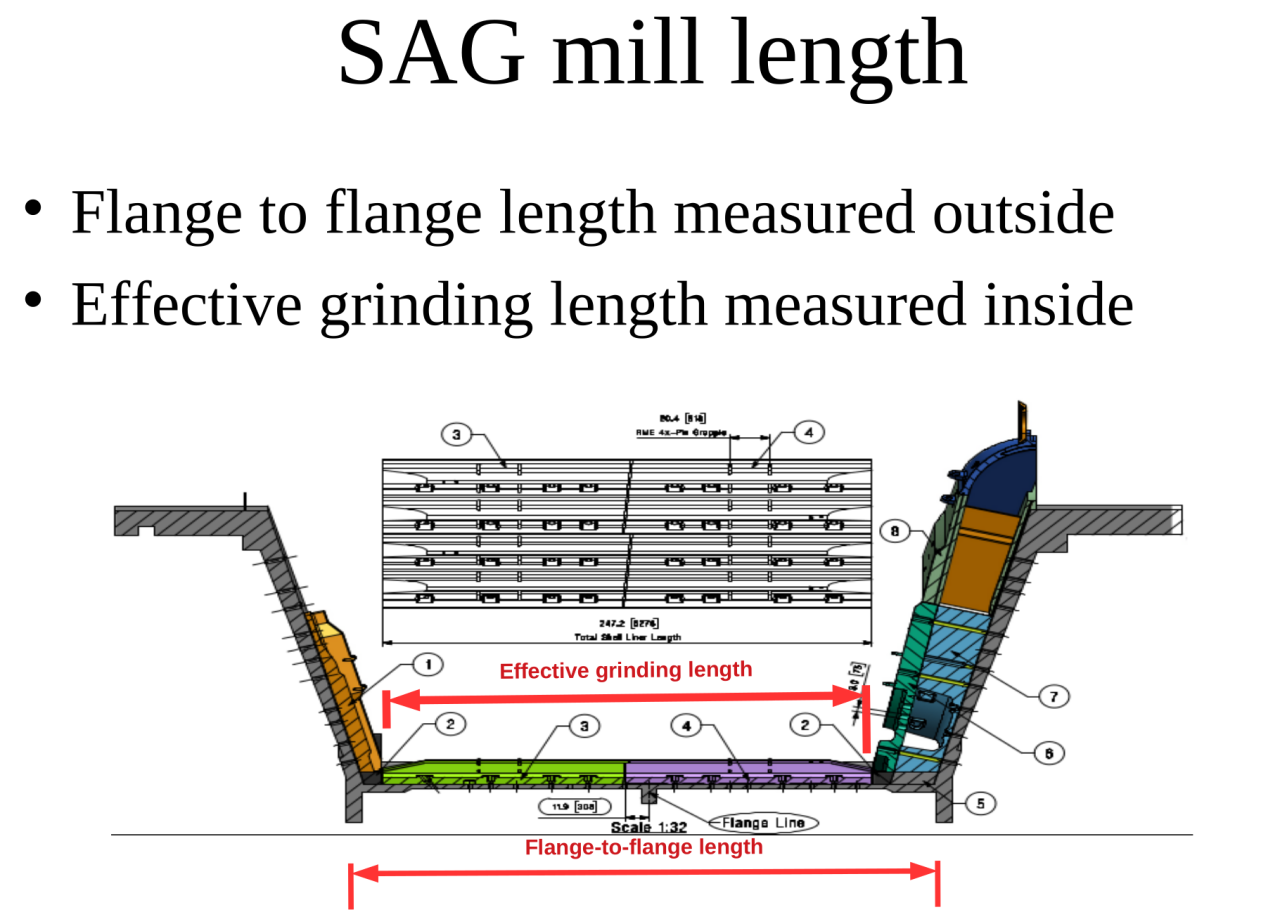
Understanding SAG Mill Length
The length of a SAG mill is typically evaluated using the Length-to-Diameter (L/D) ratio. This ratio influences how long the ore and grinding media remain inside the mill and how much opportunity they have to experience impact, abrasion, and attrition.
A longer mill generally provides:
Longer material residence time
More grinding and impact events
Increased grinding volume
Greater installed power capability
Potentially improved particle size reduction
However, increasing SAG mill length does not always guarantee better performance.
Short vs. Long SAG Mills
A short SAG mill with a relatively low L/D ratio is often preferred when high-impact breakage is required. The larger diameter promotes higher impact energy from the grinding media, making this configuration suitable for competent and coarse ore.
A longer SAG mill, on the other hand, provides additional grinding volume and residence time. This can be beneficial when processing high tonnage or when additional grinding is required before the material reaches the downstream ball mill or classification circuit.
The selection depends on several factors, including:
Ore competency and hardness
Feed size distribution
Throughput requirements
Target product size
Grinding circuit configuration
Power availability
Liner design and wear performance
The Impact on Residence Time and Throughput
Increasing SAG mill length increases the internal volume of the mill. This can allow more material to be processed or provide additional residence time for grinding.
However, excessive length may create operational challenges. Material flow through the mill can become less efficient, potentially leading to:
Higher slurry pooling
Reduced grinding efficiency
Uneven charge distribution
Increased liner wear
Higher power consumption without proportional throughput improvement
For this reason, SAG mill sizing must balance grinding volume, power intensity, and material transport.
Diameter vs. Length: Finding the Right Balance
In many modern high-capacity grinding circuits, designers often prioritize larger mill diameter rather than excessive mill length. A larger diameter increases the potential energy of the grinding media, resulting in stronger impact forces and improved breakage of large, competent ore particles.
Meanwhile, increasing mill length primarily increases grinding volume.
The ideal design therefore depends on whether the process requires:
Higher impact energy → Larger diameter may be more beneficial
Greater grinding capacity and residence time → Additional mill length may be beneficial
A properly optimized SAG mill should achieve the required throughput while maintaining efficient power utilization and avoiding unnecessary increases in capital and operating costs.
SAG mill length is not simply a matter of increasing equipment size. It is a key design parameter that affects grinding volume, residence time, material transport, power utilization, and overall circuit efficiency.
The optimal SAG mill design requires a careful balance between diameter and length, supported by ore characterization, comminution testing, process simulation, and operational experience. With the increasing use of DEM and digital engineering tools, mining operations can evaluate SAG mill geometry more accurately and optimize performance before making major capital investments.
A well-designed SAG mill is not necessarily the longest or the largest—it is the one with the right geometry for the ore and the process