Understanding Gel Point: The Key to Stable Thickener Performance and Efficient Dewatering
Author: [Ramadhani Santoso - ramadhani@meta-mineral.com ]
Category: Gel Point | Thickener Optimization | Mud Bed Monitoring | Mineral Processing | Thickener Performance | Dewatering Efficiency | Underflow Density | Solids Concentration | Compression Settling | Flocculation | Solids Residence Time | SmartDiver System | Process Optimization | Mining Operations | Meta Mineral
In mineral processing, achieving consistent thickener performance is essential for maximizing water recovery, maintaining stable underflow density, and improving downstream process efficiency. One of the most important concepts governing thickener operation is the gel point—the critical solids concentration at which a settling slurry transitions into a structured, networked material.
At concentrations below the gel point, particles primarily behave as individual solids settling under gravity. However, once the slurry reaches the gel point, particle interactions become strong enough to form a continuous network. This network creates a cohesive matrix that behaves more like a porous, semi-solid material than a freely settling suspension.
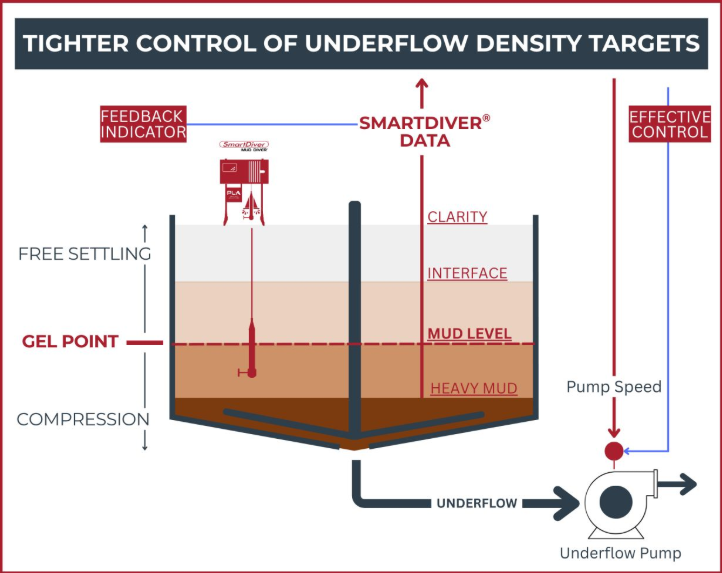
What Happens at the Gel Point?
The formation of a networked slurry structure allows the mud bed to withstand internal stresses without immediately collapsing. This creates a more stable and uniform environment for particle consolidation and compression.
Several operating and material factors influence whether the gel point can be reached and maintained, including:
Flocculation efficiency
Ore mineralogy and slurry chemistry
Mud bed height
Solids flux
Feed characteristics
The balance between feed rate and underflow discharge rate
Maintaining the right combination of these variables is critical. If the bed fails to develop or sustain a networked structure, thickener performance can become unstable.
The Consequences of a Weak or Collapsing Mud Bed
A mud bed that does not reach the gel point may lack the structural integrity required for effective compression. This can result in several operational challenges, including:
Weak bed structure that is prone to collapse
Poor rake-ability and difficult underflow discharge
Poorly defined settling zone boundaries
Uneven solids concentration throughout the thickener
Fluctuating underflow density
Reduced dewatering efficiency
These issues can create instability not only within the thickener itself but also in downstream processes that depend on consistent slurry properties.
Two Distinct Settling Regimes
The gel point represents an important threshold because it effectively divides thickener operation into two different settling regimes.
1. Above the Mud Bed: Settling and Permeability Dominated
In the zones above the mud bed, solids concentration remains below the gel point. In this region, dewatering behavior is primarily governed by:
Particle settling velocity
Floc characteristics
Liquid flow through the suspension
Permeability
The objective is to promote efficient clarification and allow solids to settle toward the compression zone.
2. Within the Mud Bed: Compression Dominated
Once the solids concentration exceeds the gel point, the slurry enters a networked state. Individual particle settling becomes less dominant, and the dewatering mechanism shifts toward compression.
In this region, the weight of the solids above creates stress on the underlying bed. Further consolidation depends on the ability of the networked structure to compact and release trapped water.
One of the most important variables in this process is solids residence time. Sufficient residence time allows the mud bed to consolidate progressively, increasing solids concentration and improving underflow density.
Why Bed Height Matters
Once a slurry has passed the gel point and formed a stable networked structure, mud bed height becomes a valuable operational indicator.
A stable and properly maintained bed provides the residence time required for effective compression. Changes in bed height can therefore indicate changes in the thickener's ability to maintain the desired underflow concentration.
However, operators need reliable information about what is happening inside the thickener. Traditional surface-level measurements alone may not provide sufficient insight into the internal structure of the settling zones and mud bed.
Improving Thickener Control with SmartDiver Monitoring
Advanced bed monitoring technologies such as the SmartDiver system can provide deeper insight into thickener behavior by helping operators monitor bed height and identify the formation of a stable, networked mud bed.
By understanding where the gel-point transition occurs and how the mud bed responds to changing operating conditions, operators can improve control over:
Mud bed stability
Compression performance
Solids residence time
Underflow density
Thickener dewatering efficiency
This information enables a more proactive approach to thickener operation, helping process engineers respond to changing feed conditions before they develop into major performance issues.
Meta Mineral's Perspective
At Meta Mineral, we understand that efficient thickener operation requires more than simply maximizing settling rates. The transition from settling to compression at the gel point is a critical part of achieving stable dewatering performance.
By combining mineral processing expertise, process analysis, and advanced monitoring technologies, operators can gain a better understanding of mud bed behavior and optimize the relationship between solids concentration, bed height, residence time, and underflow density.
A stable networked mud bed is not just an operational condition—it is the foundation for predictable and efficient thickener performance.
Understanding the gel point helps transform thickener operation from reactive control into a more stable, measurable, and optimized dewatering process.