The Silent Threat That Can Shut Down Your Grinding Circuit - Hydrocyclone Roping
Hydrocyclone Roping: The Silent Threat That Can Shut Down Your Grinding Circuit
Author: [Ramadhani Santoso - ramadhani@meta-mineral.com]
Category: Mineral Processing | Hydrocyclone Optimization | Process Improvement
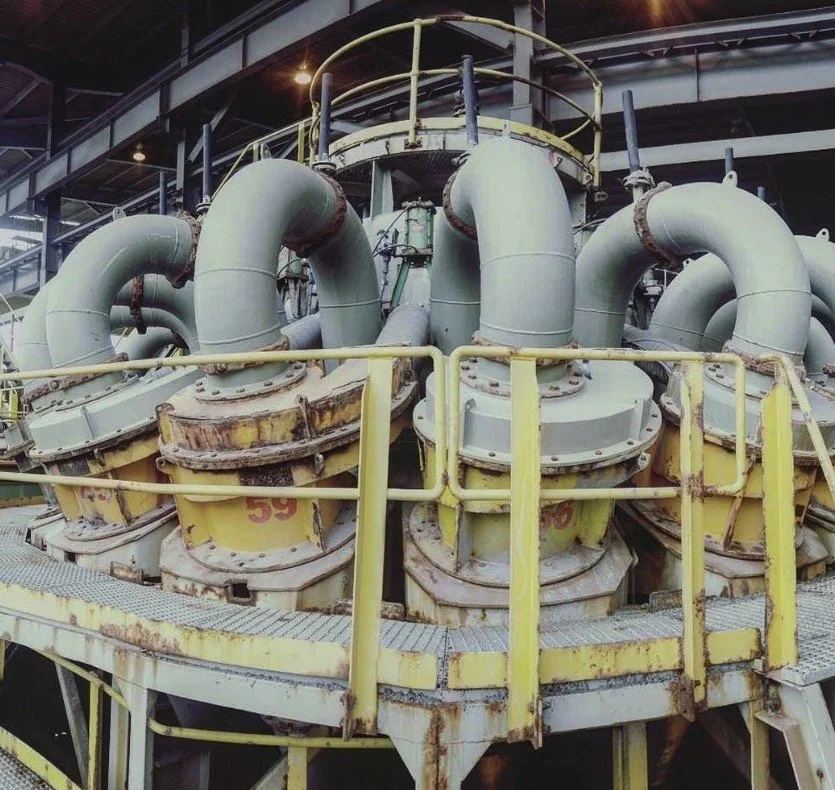
In mineral processing, every second matters. A hydrocyclone operating outside its normal condition can quickly turn a stable grinding circuit into a production bottleneck. Among all hydrocyclone operating issues, roping is one of the most critical because it directly affects particle classification, circulating load, and flotation performance.
Many operations underestimate the impact of roping until recovery drops and downstream equipment becomes overloaded. Understanding the causes, consequences, and corrective actions is essential for maintaining plant stability and maximizing metal recovery.
What is Hydrocyclone Roping?
A properly operating hydrocyclone produces a wide, umbrella-shaped spray from the underflow. This indicates that coarse particles are discharged efficiently while fine particles report to the overflow.
When a cyclone begins roping, the underflow changes from an umbrella-shaped spray into a narrow rope-like stream. This indicates that the cyclone is no longer classifying particles efficiently and that excessive solids are passing through the system.
This condition is often caused by:
Excessive feed density
Low cyclone feed pressure
Blocked apex
Worn cyclone components
Excessive circulating load
Rubber debris or foreign materials blocking the apex
Although the visual change appears simple, the process consequences are significant.
Why Roping is Dangerous
Even a short period of roping can have severe consequences throughout the concentrator.
1. Poor Particle Size Distribution (PSD)
During roping, coarse particles bypass proper classification and enter the overflow stream.
As a result:
Target grind size is lost
PSD becomes coarser than design
Downstream flotation feed quality deteriorates
The grinding circuit immediately loses classification efficiency.
2. Reduced Flotation Recovery
Flotation circuits are designed to recover minerals within a specific particle size range.
When coarse particles enter flotation:
Froth bubbles become unstable
Bubble breakage increases
Mineral attachment efficiency decreases
Overall recovery drops significantly
Instead of floating valuable minerals, the flotation cells become overloaded with coarse material.
3. Overloaded Flotation Cells
Large flotation cells are not designed to continuously handle excessive coarse solids.
For example, a concentrator with:
11 flotation cells (360 m³)
9 flotation cells (160 m³)
can quickly accumulate coarse sand at the bottom of the tanks.
Cleaning this material may require more than five hours, resulting in substantial production losses.
Impact on the Grinding Circuit
Hydrocyclone roping also destabilizes the grinding circuit.
Initially, the amount of coarse material returning to the mill appears to decrease because material accumulates inside the cyclone.
However, once the blockage is removed, the accumulated solids suddenly return to the mill.
This causes:
A sudden spike in circulating load
Ball mill overload
Increased pulp density
Reduced grinding efficiency
Higher power consumption
A thick pulp creates a cushioning effect inside the mill, reducing ball impact energy and limiting effective particle breakage.
Mineralogical Consequences
The problem becomes even more severe when processing native copper.
Unlike brittle minerals, native copper is highly ductile.
Instead of fracturing, copper particles deform and flatten under impact, making them increasingly difficult to grind. These particles continue circulating through the grinding circuit, increasing the circulating load and reducing classification efficiency.
Field Indicators of Hydrocyclone Roping
Experienced operators can often detect roping before instrumentation indicates a problem.
Typical warning signs include:
Excessive Vibration
A cyclone experiencing apex blockage often vibrates noticeably more than neighboring cyclones.
Pressure Drop with High Density
Low feed pressure combined with elevated pulp density is a strong indication that roping is beginning.
Sudden Pressure Increase
A rapid increase in cyclone pressure frequently indicates a complete blockage requiring immediate attention.
Recommended Corrective Actions
When roping is detected, operators should respond quickly:
Inspect cyclone movement and vibration.
Check the underflow discharge pattern.
Monitor feed pressure and pulp density.
Isolate the affected cyclone if necessary.
Switch immediately to a standby cyclone.
Remove apex blockages caused by rubber fragments or debris.
Restore stable operating pressure and flow rate.
Fast intervention prevents downstream process instability and minimizes production losses.
Best Practices to Prevent Roping
Maintaining stable hydrocyclone performance requires continuous monitoring of key operating variables:
Cyclone feed pressure
Pulp density
Volumetric flow rate
Apex and vortex finder condition
Particle size distribution (PSD)
Circulating load
Routine inspections and preventive maintenance can significantly reduce the risk of unexpected roping events.
Conclusion
Hydrocyclone roping is more than a classification issue—it is a process-wide event that affects grinding efficiency, flotation recovery, equipment utilization, and overall plant productivity.
By recognizing early warning signs, maintaining stable operating conditions, and responding rapidly to abnormalities, mineral processing plants can protect circuit stability, optimize particle size distribution, and maximize metal recovery.
In mineral processing, every minute of stable cyclone operation contributes directly to improved recovery and sustained production performance.