

Particle Size Analysis: The Invisible Science Driving Mining Profitability
Why particle size distribution is one of the most important variables in mineral processing
Author: [Ramadhani Santoso - ramadhani@meta-mineral.com]
Category: Mineral Processing | Hydrocyclone Optimization | Process Improvement | Particle Size Analysis
Introduction
In mining and mineral processing, production performance is often associated with larger equipment, higher throughput, or advanced process control systems. However, one of the most influential variables is frequently overlooked: particle size distribution (PSD).
From crushing and grinding to flotation, leaching, and dewatering, the size of mineral particles determines how efficiently valuable minerals are liberated, separated, and recovered. A poorly controlled PSD can significantly reduce recovery, increase energy consumption, and raise operating costs.
Particle size analysis is therefore much more than a laboratory quality control activity—it is a strategic tool for maximizing plant performance and profitability.
What is Particle Size Distribution?
Particle Size Distribution (PSD) describes the proportion of particles within different size ranges in an ore or process stream.
Unlike a single particle size measurement (such as P80), PSD provides a complete picture of the material, including:
Coarse particle fraction
Medium particle fraction
Fine particles
Ultrafines or slimes
Typical measurement techniques include:
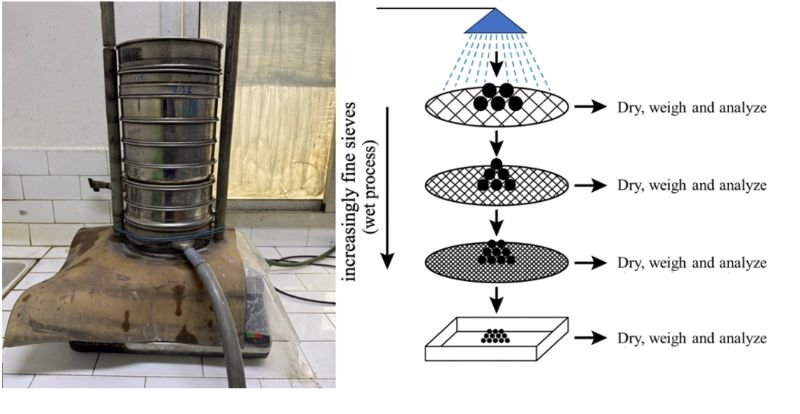
Dry and wet sieve analysis
Laser diffraction
Dynamic image analysis
Online particle size analyzers
Automated mineralogy systems
Understanding PSD enables engineers to evaluate how material behaves throughout the mineral processing circuit.
Why Particle Size Matters Throughout the Process
1. Crushing and Grinding
Comminution accounts for 40–60% of total energy consumption in many mineral processing plants.
The objective is not to produce the finest possible particles—it is to achieve the optimum liberation size.
Problems caused by improper grinding include:
Under-grinding
Poor mineral liberation
Reduced recovery
Lower concentrate grade
Over-grinding
Excessive energy consumption
Generation of slimes
Increased equipment wear
Reduced flotation efficiency
Optimizing PSD allows plants to minimize energy while maximizing mineral liberation.
2. Flotation Performance
Flotation recovery is highly dependent on particle size.
Generally:
Coarse particles have lower probability of bubble attachment.
Ultrafine particles exhibit poor collision efficiency and entrainment.
Intermediate particle sizes usually provide the highest recovery.
Maintaining the target PSD helps stabilize flotation kinetics and improve:
Recovery
Concentrate grade
Reagent efficiency
Froth stability
3. Leaching Efficiency
Hydrometallurgical processes rely on sufficient surface area for chemical reactions.
Smaller particles provide:
Higher reaction rates
Faster dissolution
Improved metal extraction
However, excessive grinding can create filtration challenges, higher acid consumption, and poor solid-liquid separation.
Finding the optimum particle size balances extraction efficiency with downstream processing costs.
4. Thickening, Filtration, and Tailings
Particle size strongly influences:
Settling velocity
Water recovery
Filter cake permeability
Tailings management
Too many fine particles can lead to:
Slow thickener performance
High water retention
Poor filtration
Increased tailings storage challenges
PSD control therefore impacts both production and environmental performance.
Economic Impact of PSD Control
A well-controlled PSD can deliver measurable operational benefits:
Performance IndicatorBenefitEnergy ConsumptionLower grinding power requirementsMetallurgical RecoveryHigher recovery of valuable mineralsEquipment WearLonger mill liner and grinding media lifeReagent ConsumptionReduced chemical usagePlant StabilityMore consistent operationProduct QualityImproved compliance with customer specifications
Even a small improvement in recovery—such as 1–2%—can translate into millions of dollars annually for large mining operations.
The Importance of Representative Sampling
Accurate particle size analysis begins with representative sampling. Even the most advanced analytical instrument cannot compensate for a biased sample.
Representative sampling ensures that laboratory or online measurements accurately reflect the bulk material, providing reliable data for operational decisions. Best practices include:
Following the Theory of Sampling (TOS)
Avoiding segregation during sample handling
Using appropriate sample reduction techniques
Maintaining consistent sampling intervals
Implementing QA/QC protocols
Without representative sampling, PSD data may lead to incorrect process adjustments and reduced plant performance.
Best Practices for Process Optimization
Mining operations should integrate particle size analysis into routine process control by:
Establishing target PSDs for each processing stage
Monitoring PSD in real time where possible
Linking PSD data with recovery and energy consumption
Using predictive analytics for grinding circuit optimization
Combining PSD with mineralogical characterization and liberation analysis
Continuously validating sampling and analytical procedures
Looking Ahead: Digital Particle Size Management
The future of mineral processing lies in intelligent, data-driven operations. By integrating online particle size measurements with AI-powered process control, mining companies can:
Predict process disturbances before they occur
Optimize grinding energy in real time
Improve metallurgical recovery
Reduce operational costs
Support sustainable mining practices
Particle size analysis is evolving from a laboratory measurement into a cornerstone of digital mining and smart mineral processing.
Conclusion
Particle size distribution is one of the most influential variables in mineral processing. It affects energy efficiency, mineral liberation, flotation performance, leaching kinetics, product quality, and overall plant economics.
As mining operations embrace digital transformation, integrating representative sampling, real-time particle size analysis, and advanced analytics will become essential for achieving higher productivity and sustainable profitability.
In modern mineral processing, particle size is no longer just a quality control metric—it is a strategic performance indicator that drives operational excellence.