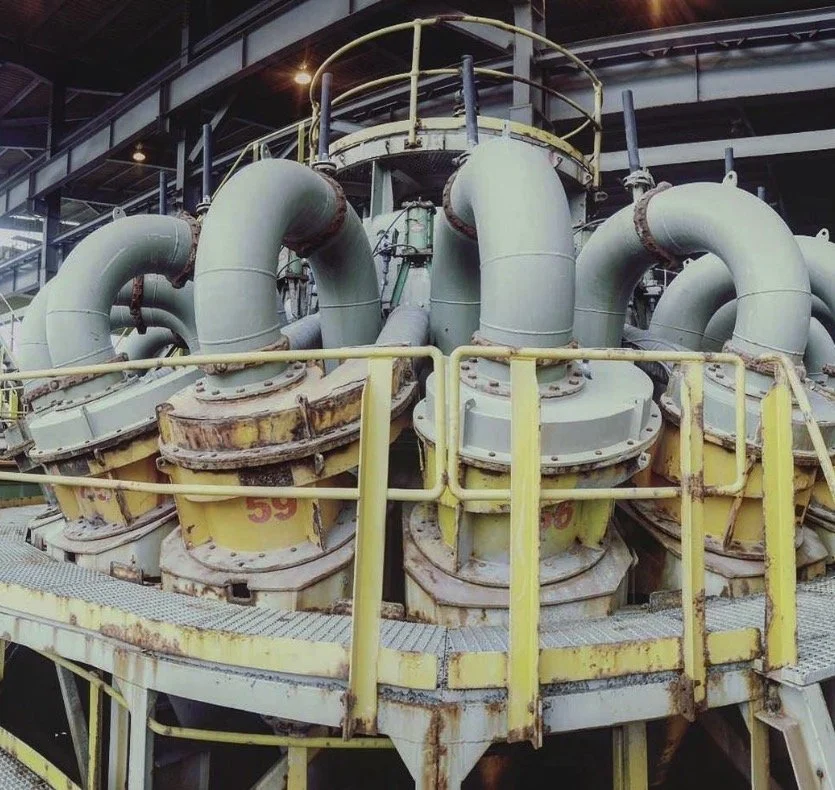
Grinding Circuit Performance - Hydrocyclone
Hydrocyclone Apex-to-Vortex Ratio: The Hidden Parameter That Can Transform Grinding Circuit Performance
Author: [Ramadhani Santoso - ramadhani@meta-mineral.com]
Category: Mineral Processing | Hydrocyclone Optimization | Process Improvement
Introduction
In mineral processing, hydrocyclones are often optimized by adjusting operating variables such as feed pressure, slurry density, and feed solids concentration. While these parameters are undoubtedly important, one critical design factor is frequently overlooked—the Apex-to-Vortex (A/V) Ratio.
The A/V ratio significantly influences classification efficiency, circulating load, grinding energy consumption, and ultimately, plant recovery. Even small changes in this geometric relationship can have a measurable impact on overall circuit performance.
Understanding and optimizing the A/V ratio enables plant operators and metallurgists to maximize throughput while maintaining stable operation.
Understanding the Apex-to-Vortex Ratio
A hydrocyclone separates particles using centrifugal forces generated by the swirling motion of slurry inside the cyclone.
Two components primarily control the discharge flow:
Apex (Spigot): The bottom opening where coarse particles leave through the underflow.
Vortex Finder: The overflow pipe that removes fine particles and water.
The Apex-to-Vortex (A/V) Ratio is defined as:
A/V Ratio = Apex Diameter ÷ Vortex Finder Diameter
This ratio governs the balance between underflow and overflow flow patterns, making it one of the most influential design parameters in cyclone performance.
Why the A/V Ratio Matters
An optimized A/V ratio helps achieve:
High classification efficiency
Stable grinding circuit operation
Lower circulating load
Reduced over-grinding
Improved downstream recovery
Lower energy consumption
Conversely, an inappropriate ratio can reduce circuit efficiency even when pressure and density remain within their target ranges.
The Optimal Operating Range
For many grinding and classification applications, practical experience suggests an A/V ratio between approximately 0.35 and 0.50 provides a good balance between efficiency and operational stability.
However, the optimum value depends on several factors, including:
Ore characteristics
Cyclone diameter
Feed size distribution
Target grind size (P80)
Desired throughput
Operating pressure
Therefore, the A/V ratio should always be optimized alongside the overall circuit design rather than treated as a fixed rule.
When the A/V Ratio Is Too Low
An A/V ratio below approximately 0.35 generally indicates that the apex is relatively small compared with the vortex finder.
Potential consequences include:
Increased Over-Grinding
Fine particles remain in the grinding circuit longer than necessary, increasing mill residence time.
Higher Energy Consumption
The grinding mill expends additional energy reducing already-fine particles.
Increased Circulating Load
Material recycles repeatedly through the mill and cyclone, limiting circuit capacity.
Accelerated Wear
Higher internal velocities and excessive solids circulation increase wear on pumps, pipes, cyclone liners, and grinding media.
When the A/V Ratio Is Too High
When the ratio exceeds approximately 0.50, the apex becomes relatively large.
This condition may result in:
Coarse Particle Bypass
Particles that should continue grinding may report directly to overflow.
Reduced Liberation
Insufficient grinding leaves valuable minerals locked within gangue.
Lower Recovery
Poor liberation reduces flotation or leaching performance downstream.
Product Quality Issues
The final grind size may become coarser than specification.
Best Practices for Maintaining Peak Performance
Optimizing hydrocyclone performance requires more than selecting the correct apex size.
1. Monitor Key Process Variables
Track:
Overflow P80
Underflow density
Feed pressure
Feed solids concentration
Cyclone feed rate
Continuous monitoring enables operators to identify performance drift before production losses occur.
2. Replace Worn Components
Cyclone components gradually wear during operation.
Regular inspection and replacement of:
Apex
Vortex finder
Liners
helps maintain the intended geometry and classification performance.
3. Optimize the Entire Grinding Circuit
Hydrocyclones should never be optimized in isolation.
Performance depends on interactions with:
Grinding mills
Pumps
Screens
Sumps
Process control systems
A systems-based optimization approach typically delivers greater improvements than changing cyclone components alone.
Practical Considerations
While the A/V ratio is an important design parameter, it should not be interpreted as a universal operating target. The ideal ratio varies depending on ore type, cyclone size, operating pressure, and plant objectives. Changes to apex or vortex finder dimensions should therefore be evaluated alongside process data, pilot testing, or simulation before implementation.
Conclusion
The Apex-to-Vortex ratio is one of the most influential—and often overlooked—parameters in hydrocyclone performance. By maintaining an appropriate balance between the apex and vortex finder dimensions, mineral processing plants can improve classification efficiency, reduce energy consumption, stabilize grinding circuits, and enhance downstream recovery.
Rather than focusing solely on operating variables such as pressure or slurry density, engineers should also consider cyclone geometry as a powerful lever for process optimization. In many cases, meaningful improvements in plant performance can be achieved not by installing larger equipment, but by ensuring the hydrocyclone is configured with the right geometry for the application.
References
Wills, B. A., & Finch, J. A. (2016). Wills’ Mineral Processing Technology: An Introduction to the Practical Aspects of Ore Treatment and Mineral Recovery (8th ed.). Elsevier.
Napier-Munn, T. J., et al. (1996). Mineral Comminution Circuits: Their Operation and Optimisation. JKMRC, University of Queensland.
Plitt, L. R. (1976). “A Mathematical Model of the Hydrocyclone Classifier.” CIM Bulletin.
Bradley, D. (1965). The Hydrocyclone. Pergamon Press.
Lynch, A. J. (1977). Mineral Crushing and Grinding Circuits. Elsevier.
Note: The commonly cited A/V ratio range of 0.35–0.50 is a practical industry guideline and should be validated for each application through plant testing or simulation, as it is not a universal value specified by a single industry standard or reference.