Selecting the Right Industrial Melting Furnace: Engineering Trade-Offs Between Induction, EAF, Cupola, and Reverberatory Systems
Author: [Ramadhani Santoso - ramadhani@meta-mineral.com ]
Category: Foundry Engineering | Metal Melting Technology | Metallurgical Engineering | Furnace Design & Operation | Industrial Heating Systems | Steelmaking Technology | Aluminum Melting | Cast Iron Production | Induction Furnace | Electric Arc Furnace (EAF) | Cupola Furnace | Reverberatory Furnace | Foundry Process Engineering | Energy Efficiency in Foundries | Metallurgical Process Optimization
In industrial foundry operations, furnace selection is not simply a question of melting capacity. The melting technology determines the plant’s production rate, metallurgical control, energy efficiency, raw-material flexibility, alloy-changeover capability, emissions profile, and ultimately operating cost.
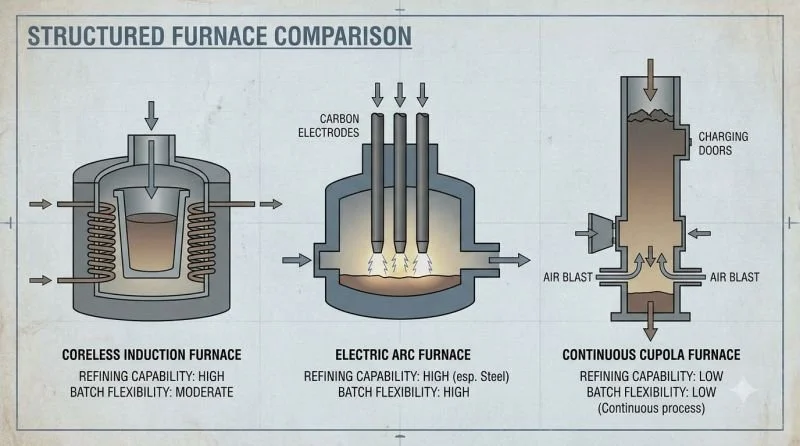
electric arc furnace
While the coreless induction furnace has become a preferred solution for high-mix, batch-oriented melting, it is not necessarily the optimum technology when the primary objective is continuous high-volume production or aggressive metallurgical refining. Furnace selection must therefore be aligned with the characteristics of the feedstock, required metal quality, production schedule, and downstream casting process.
1. Electric Arc Furnace (EAF): High-Tonnage Melting and Aggressive Refining
The Electric Arc Furnace (EAF) is the preferred technology for large-scale steelmaking, particularly where the charge contains significant quantities of scrap or variable-quality metallic feedstock.
Unlike an induction furnace, an EAF can generate and maintain a highly reactive slag-metal system. This provides the metallurgical environment required for oxidation, impurity removal, decarburization, and temperature control.
One of the major advantages of EAF technology is its ability to accommodate highly contaminated or variable scrap. Through controlled slag practice, operators can remove undesirable elements and manage impurities such as sulfur and phosphorus more effectively than with a conventional induction melting route.
From an engineering perspective, EAFs are therefore particularly attractive when:
Steel production tonnage is high.
Scrap quality and chemistry vary significantly.
Metallurgical refining is required during melting.
High productivity is more important than frequent alloy changeovers.
The plant can support substantial electrical infrastructure and furnace auxiliaries.
The trade-off is that EAF operation requires sophisticated electrode control, slag management, fume extraction, refractory management, and electrical-power systems. These auxiliary systems contribute significantly to both capital expenditure and operating complexity.
2. Channel Induction Furnace: Efficient Continuous Melting and Holding
A channel induction furnace operates differently from a coreless induction furnace. Rather than melting the entire charge from a cold start, the channel furnace normally maintains a permanent molten-metal heel through which electrical energy is transferred efficiently.
This configuration makes channel induction furnaces particularly suitable for continuous holding, duplex melting systems, automated pouring, and high-utilization production lines.
The permanent molten heel provides an important energy advantage. Because the furnace does not repeatedly heat the entire metal inventory from ambient temperature, electrical energy can be used more efficiently for maintaining temperature and processing incoming material.
However, this same characteristic creates an operational limitation: alloy changeover becomes significantly more difficult.
Residual metal from the previous alloy remains in the furnace, meaning that changing chemistry may require extensive dilution, draining, cleaning, or controlled transition melting. Consequently, channel furnaces are best suited to plants producing large quantities of relatively consistent alloys.
Typical applications include:
Continuous cast-iron production.
Automated pouring systems.
Duplex melting arrangements.
High-volume holding and temperature control.
Production lines requiring stable metal availability.
The engineering decision is therefore straightforward: channel induction technology is highly effective when continuity and energy efficiency outweigh flexibility.
3. Cupola Furnace: Continuous High-Volume Iron Melting
For many traditional iron foundries, the cupola furnace remains one of the most productive technologies for continuous melting of cast iron.
The cupola is fundamentally different from an electric induction furnace because it combines melting, combustion, carburization, and metallurgical reactions within a continuous shaft furnace. Coke acts as both a fuel and a carbon source, while the charge typically consists of iron-bearing metallics, fluxes, and coke.
This provides a major advantage for high-volume production of grey iron and ductile iron base metal, particularly where a continuous melting stream is required.
The cupola can deliver exceptionally high melting rates and relatively low direct melting costs under suitable operating conditions. However, its environmental and operational requirements are substantial.
Modern cupola installations require extensive systems for:
Furnace gas collection.
Particulate and fume control.
Sulfur management.
Slag handling.
Coke and raw-material management.
Process monitoring and emission compliance.
Consequently, the apparent economic advantage of cupola melting must be evaluated together with the capital and operating cost of environmental control systems.
For very high-volume iron production, however, the cupola remains difficult to match in terms of continuous melting productivity.
4. Reverberatory Furnace: High-Volume Aluminum Melting
For high-volume aluminum processing, particularly in die-casting operations, the reverberatory furnace remains an important melting and holding technology.
Instead of directly coupling electrical energy into the metal, the furnace transfers heat primarily through radiation and convection from gas-fired combustion systems. This configuration allows the furnace to maintain a large molten-metal inventory and is well suited to continuous industrial production.
The major advantage is scale. Large reverberatory furnaces can economically maintain substantial quantities of molten aluminum, providing a stable metal supply to high-throughput casting operations.
However, aluminum quality introduces another critical engineering challenge: hydrogen porosity and non-metallic inclusions.
Molten aluminum can absorb hydrogen, and hydrogen solubility changes significantly as the metal solidifies. Without appropriate melt treatment, dissolved hydrogen can form internal porosity during solidification, compromising mechanical properties and casting integrity.
For this reason, industrial aluminum melting systems commonly incorporate controlled rotary degassing, flux treatment, filtration, and melt-cleanliness procedures.
Furnace capacity alone therefore does not determine casting quality. The complete process must integrate:
melting → holding → degassing → filtration → temperature control → casting
Choosing the Furnace Based on Process Requirements
There is no universally superior furnace technology. The correct choice depends on the interaction between production volume, alloy flexibility, feedstock quality, metallurgical requirements, and process continuity.
Furnace TechnologyPrimary StrengthBest ApplicationMajor LimitationCoreless InductionFlexibility and clean meltingHigh-mix batch productionLimited refining capabilityEAFHigh productivity and slag refiningHigh-tonnage steelmakingHigh electrical and auxiliary-system requirementsChannel InductionEfficient continuous holdingContinuous production and automated pouringDifficult alloy changeoverCupolaVery high continuous iron melting rateLarge iron foundriesEmissions and coke-management requirementsReverberatoryLarge molten-metal inventoryHigh-volume aluminum castingRequires rigorous melt-quality control
Furnace Selection Is a Plant-Level Engineering Decision
The most efficient furnace is not necessarily the one with the lowest specific energy consumption. A furnace with excellent melting efficiency can become economically unattractive if it cannot accommodate the plant's alloy-change frequency, raw-material variability, required production rate, or metallurgical specifications.
A robust furnace-selection study should therefore evaluate at least five parameters:
Metal throughput — required tonnes per hour or tonnes per day.
Feedstock quality — consistency, contamination, oxidation, and chemistry.
Metallurgical requirements — refining, desulfurization, dephosphorization, carburization, degassing, and inclusion control.
Production strategy — batch, campaign, continuous melting, holding, or duplex operation.
Total cost of ownership — energy, electrodes or fuel, refractories, labor, maintenance, emissions control, and downtime.
The key engineering principle is simple: furnace technology must be selected around the entire metallurgical process, not merely the melting step.
A coreless induction furnace may be the optimal solution for a flexible foundry producing many alloys in relatively small batches. An EAF becomes more attractive when high-tonnage steel production and aggressive slag refining dominate the process. Channel induction technology excels when continuous metal availability and energy efficiency are critical, while cupolas remain powerful solutions for very high-volume iron melting. For aluminum, reverberatory systems can provide the large molten-metal inventory required by high-throughput casting operations, provided that melt cleanliness and hydrogen control are properly engineered.