How to Choose the Right Refractory for Each Zone of a Rotary Kiln
Author: [Ramadhani Santoso - ramadhani@meta-mineral.com ]
Category: high alumina refractory, magnesia spinel bricks, rotary kiln burning zone, kiln refractory materials, cement plant refractory, refractory castables, kiln maintenance, cement manufacturing, refractory lining failure
Refractory selection is a critical factor in maintaining kiln reliability, thermal efficiency, production stability, and equipment service life. A cement rotary kiln does not experience the same operating conditions along its entire length. Each zone is exposed to different combinations of temperature, abrasion, thermal shock, chemical attack, and mechanical stress.
For this reason, selecting a refractory simply because it has the highest temperature rating is not always the best engineering approach. The correct refractory should be matched to the specific operating conditions of each kiln zone.
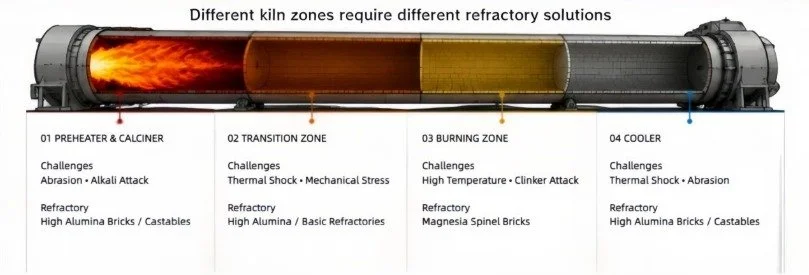
refractory rotary kiln
Refractory Selection by Cement Kiln Zone
1. Preheater and Calciner Zone
The preheater and calciner areas experience significant abrasion, alkali attack, dust circulation, and thermal loading. Refractory materials must therefore provide good resistance to chemical attack and mechanical wear.
Typical refractory selection:
High alumina bricks
High alumina castables
Abrasion-resistant castables
High-alumina refractories are commonly considered where abrasion and alkaline exposure are important factors.
2. Transition Zone
The transition zone is exposed to changing thermal conditions and mechanical stresses. Refractory failure can occur when the lining cannot accommodate repeated temperature fluctuations and mechanical loading.
Typical refractory selection:
High alumina refractories
Basic refractories
Specialized thermal-shock-resistant materials
The selection should consider both thermal shock resistance and mechanical stability, rather than temperature capability alone.
3. Burning Zone
The burning zone represents one of the most demanding areas of a cement rotary kiln. It operates at very high temperatures and is exposed to molten clinker, chemical reactions, thermal cycling, and mechanical stress.
Typical refractory selection:
Magnesia-spinel bricks
Other basic refractory systems designed for clinker-contact conditions
Magnesia-spinel refractories are widely associated with burning-zone applications because of their combination of high-temperature performance, chemical resistance, and resistance to clinker-related attack.
4. Cooler Zone
The cooler is characterized by rapid temperature changes, thermal shock, clinker impact, and abrasion. Refractory materials therefore need to withstand mechanical wear as well as repeated thermal cycling.
Typical refractory selection:
High alumina bricks
High alumina castables
Abrasion-resistant castables
The optimum material depends on factors such as clinker temperature, impact severity, cooler configuration, and maintenance strategy.
Why Refractory Selection Matters
Incorrect refractory selection can lead to premature lining deterioration, increased maintenance requirements, unplanned kiln stoppages, and reduced production availability.
A refractory with an excellent maximum temperature rating may still perform poorly if it has inadequate resistance to abrasion, alkali attack, thermal shock, clinker penetration, or mechanical stress.
The engineering approach should therefore evaluate the complete operating environment of each zone.
Key Factors for Refractory Selection
When selecting refractory materials for a cement rotary kiln, consider:
Operating temperature
Thermal shock
Abrasion and clinker impact
Alkali and chemical attack
Clinker interaction
Mechanical stress
Kiln atmosphere
Coating formation
Kiln operating stability
Expected refractory service life
The Bottom Line
There is no single refractory material that is ideal for every part of a cement rotary kiln. Preheater, calciner, transition, burning, and cooler zones each require different performance characteristics.
The best refractory is not necessarily the material with the highest temperature rating. It is the material that provides the right combination of thermal, mechanical, abrasion, and chemical resistance for the actual conditions in each kiln zone.
For cement plants, a zone-by-zone refractory selection strategy can help improve kiln reliability, refractory campaign life, maintenance planning, and overall plant performance.