Heap Leach Failure: Causes, Prevention, and Engineering Solutions
Maximizing Recovery Through Data-Driven Heap Leach Engineering
Author: [Ramadhani Santoso - ramadhani@meta-mineral.com ]
Category: Mineral Processing | Hydrocyclone Optimization | Process Improvement
Heap leaching has become one of the most efficient and cost-effective technologies for extracting valuable metals from low-grade ores. It is widely applied in gold, copper, nickel, and uranium mining because of its relatively low capital investment and scalable operation.
However, successful heap leach operations depend on much more than simply stacking ore and applying leaching solution. Poor engineering design, inadequate ore characterization, operational inefficiencies, or unfavorable geotechnical conditions can significantly reduce metal recovery and increase operating costs.
Understanding the root causes of heap leach failure enables mining companies to improve recovery, reduce risk, and maximize project profitability.
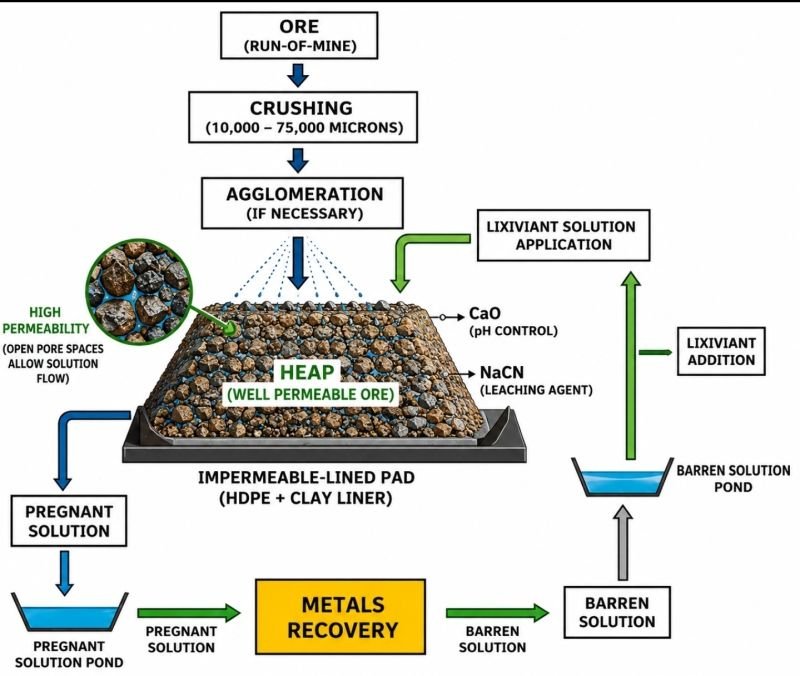
Heap Leach Engineering
What Is Heap Leach Failure?
Heap leach failure refers to any condition that prevents a heap leach facility from achieving its intended metallurgical, hydraulic, or geotechnical performance.
Failure does not always mean a catastrophic slope collapse. In many operations, the earliest indicators are subtle reductions in recovery efficiency, uneven solution flow, or increasing reagent consumption.
Common symptoms include:
Lower-than-expected metal recovery
Slow leaching kinetics
Solution ponding
Hydraulic channeling
Reduced heap permeability
Excessive acid or cyanide consumption
Heap settlement or instability
Liner leakage
Increased operating costs
Most heap leach failures result from several interconnected factors rather than a single engineering issue.
Major Causes of Heap Leach Failure
1. Inadequate Ore Characterization
Ore properties determine how effectively leaching solutions interact with valuable minerals.
Critical parameters include:
Particle size distribution
Mineralogy
Clay content
Hydraulic conductivity
Acid consumption
Porosity
Fracture characteristics
Metal liberation
Insufficient testing often leads to poor process design and lower recovery.
Best Practice
A comprehensive characterization program should include:
Bottle roll testing
Column leach testing
Mineralogical analysis (QEMSCAN or MLA)
Geotechnical testing
Hydraulic conductivity measurements
2. Poor Crushing and Agglomeration
Particle size directly influences solution flow through the heap.
Excessive fines reduce permeability and promote ponding, while overly coarse particles reduce mineral exposure and slow dissolution.
Improper agglomeration may result in:
Particle segregation
Agglomerate breakdown
Reduced permeability
Uneven solution distribution
Optimizing crushing and agglomeration improves both recovery and operational stability.
3. Non-Uniform Solution Distribution
Efficient heap leaching requires even irrigation across the entire heap surface.
Common operational problems include:
Blocked emitters
Pressure variation
Incorrect sprinkler spacing
Damaged drip lines
Poor maintenance
These issues create dry zones, preferential flow paths, and localized ponding, leaving valuable ore untreated.
Modern drip irrigation systems help improve solution uniformity while reducing evaporation losses.
4. Hydraulic Channeling
Hydraulic channeling occurs when leaching solution follows preferential pathways instead of flowing uniformly through the heap.
Typical causes include:
Ore segregation
Layering during stacking
Large void spaces
Cracking
Differential settlement
Poor agglomeration
Channeling significantly decreases metal recovery because large portions of the heap remain under-leached.
5. Geotechnical Instability
A heap leach facility is essentially a large engineered earth structure.
Potential stability issues include:
Weak foundation materials
Excess pore pressure
Excessive heap height
Steep slope angles
Heavy rainfall infiltration
Seismic loading
Modern heap leach engineering incorporates slope stability analysis, drainage design, and continuous monitoring to minimize geotechnical risk.
6. Liner and Drainage System Failure
The liner system protects groundwater and recovers process solution efficiently.
Common causes of failure include:
Mechanical damage
Differential settlement
Installation defects
Sharp rock punctures
Poor drainage design
Robust quality assurance and quality control (QA/QC) during construction are essential for long-term environmental protection.
7. Metallurgical and Chemical Challenges
Not all heap leach failures are mechanical.
Poor process chemistry can significantly reduce metal dissolution.
Critical operating parameters include:
pH
Oxidation-reduction potential (ORP)
Cyanide or acid concentration
Dissolved oxygen
Metal concentration
Temperature
Routine monitoring ensures optimal leaching conditions throughout the operational life of the heap.
8. Climate and Environmental Factors
Environmental conditions strongly influence heap performance.
Heavy rainfall may cause:
Solution dilution
Surface erosion
Ponding
Reduced permeability
Slope instability
Conversely, high evaporation rates and freezing temperatures can reduce leaching efficiency.
Site-specific climate analysis should therefore be incorporated into the design phase.
Warning Signs of Heap Leach Performance Problems
Early detection significantly reduces operational losses.
Mining operators should monitor:
Declining recovery trends
Increasing reagent consumption
Uneven irrigation patterns
Ponding on the heap surface
Excessive settlement
Reduced solution flow rates
Elevated moisture zones
Slope deformation
Changes in pregnant leach solution chemistry
Real-time monitoring systems can identify these issues before they become major operational problems.