Bulk Solid Storage Equipment: A Practical Guide for Mineral Processing Plants
Author: [Ramadhani Santoso - ramadhani@meta-mineral.com ]
Category: Bulk Solid Storage Equipment | Bulk Material Storage Equipment | Mineral Processing Storage Equipment | Bulk Solids Handling | Bulk Material Handling | Mineral Storage Systems | Ore Storage Equipment | Mining Material Storage | Bulk Storage Systems | Industrial Storage Equipment | Mineral Processing Equipment | Material Handling Equipment | Ore Handling Systems | Bulk Material Storage Systems | Mining Storage Solutions | Solid Material Storage | Storage Bin | Hopper | Silo | Bunker | Surge Bin | Day Bin | Live Bottom Bin | Stockpile | Ore Stockpile | Hopper Design | Silo Design | Bulk Solids Flowability | Mineral Processing Plant | Mining Material Handling
In mineral processing and bulk material handling plants, effective storage is an essential part of maintaining a stable and reliable production process. Minerals, ores, concentrates, coal, limestone, cement, and other bulk solids must often be stored temporarily between different stages of processing, transportation, and production.
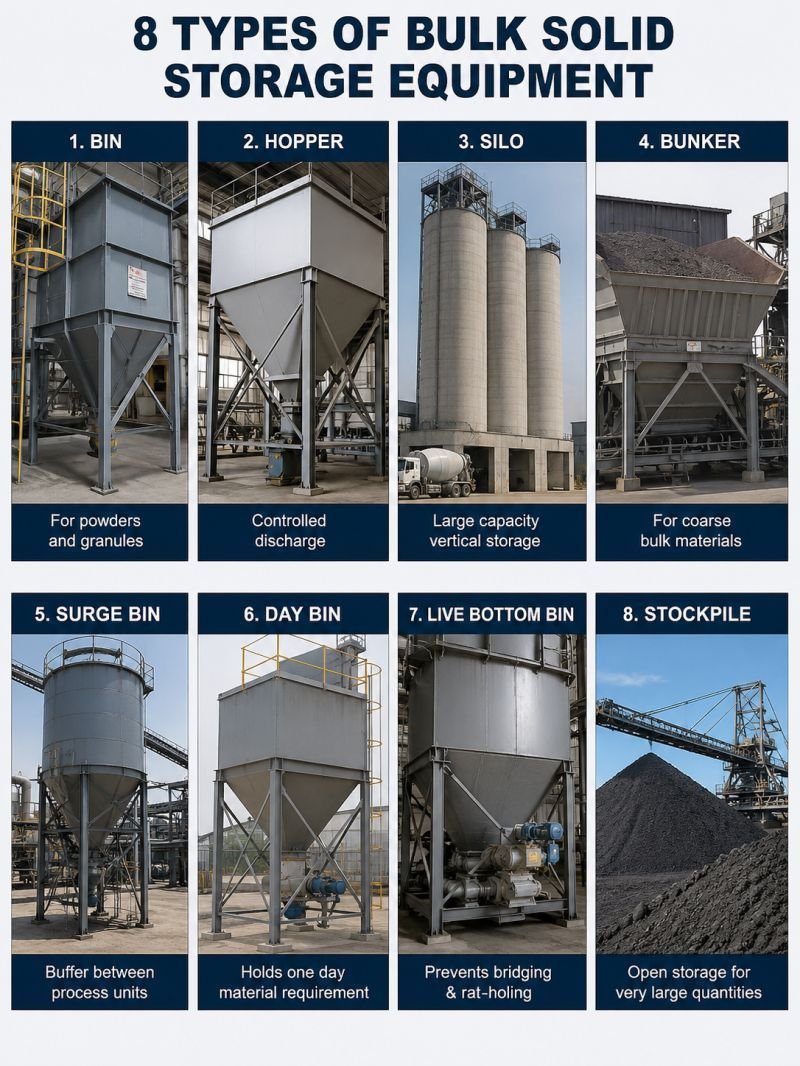
bulk solid storage equipment
The selection of bulk solid storage equipment depends on several factors, including material characteristics, storage capacity, flowability, moisture content, particle size, handling rate, and the required residence time. Common storage systems include bins, hoppers, silos, bunkers, surge bins, day bins, live-bottom bins, and stockpiles.
1. Bin
A bin is generally used for relatively small-capacity storage of bulk solids. Bins are particularly useful for powders, granules, and other materials that require short-term storage before being fed into the next process.
In mineral processing plants, bins can be installed upstream of feeders, crushers, mills, screens, or other equipment to provide a controlled supply of material.
2. Hopper
A hopper is designed to facilitate the gravity flow of bulk solids. Its typically conical or inclined bottom directs material toward a discharge point, where a feeder or conveyor can control the flow.
Hoppers are commonly positioned above feeders and conveyors. Proper hopper design is important because poorly designed systems can experience bridging, rat-holing, segregation, and inconsistent material discharge.
3. Silo
A silo is a tall, vertical storage structure designed for relatively large quantities of bulk solids. Silos are widely used for materials such as cement, fly ash, grains, powders, and plastic pellets.
In mineral and cement plants, silos provide controlled storage while minimizing the footprint required for large-volume material storage. Depending on the application, silos may incorporate aeration systems, level measurement, dust collection, and controlled discharge equipment.
4. Bunker
A bunker provides large-volume storage with a relatively wide cross-section. Unlike many vertical silos, bunkers are particularly suitable for coarse and heavy bulk materials.
Typical applications include the storage of:
Coal
Limestone
Iron ore
Crushed rock
Mineral aggregates
Bunker geometry and discharge design must account for the particle size distribution, bulk density, moisture, and flowability of the stored material.
5. Surge Bin
A surge bin acts as a buffer between two process units. Its primary purpose is to absorb variations in material flow and maintain a more stable feed to downstream equipment.
For example, fluctuations between a crushing circuit and a grinding circuit can be managed using a surge bin. By providing intermediate storage, the bin helps maintain continuous plant operation and reduces interruptions caused by fluctuating feed rates.
6. Day Bin
A day bin stores enough material to support a production shift or approximately one day's operation, depending on plant design.
Because day bins are generally located close to processing equipment, they can improve operational efficiency by ensuring that critical equipment has a readily available supply of feed material.
They are particularly useful when upstream material handling systems operate intermittently or when the plant requires additional feed security.
7. Live-Bottom Bin
A live-bottom bin incorporates mechanical extraction equipment, such as screws or moving belts, at the bottom of the storage unit.
This design is especially useful for materials that have poor flowability and are susceptible to bridging or rat-holing.
Live-bottom systems can provide controlled and consistent material extraction from the entire storage area. They are therefore valuable when handling cohesive, wet, sticky, or difficult-flowing bulk solids.
8. Stockpile
A stockpile is an open storage system rather than an enclosed vessel. It is commonly used when extremely large quantities of bulk material need to be stored economically.
Typical applications include:
Coal
Sand
Iron ore
Limestone
Aggregates
Crushed minerals
Stockpiles generally provide one of the most economical solutions for very large storage capacities. However, they require consideration of material segregation, dust emissions, drainage, environmental exposure, reclaiming systems, and available land area.
Choosing the Right Bulk Storage System
Selecting storage equipment for a mineral processing plant requires more than simply determining the required volume. Engineers should consider the bulk material properties and the interaction between storage equipment and the overall process flow sheet.
Important design parameters include:
Material characteristics: particle size, bulk density, moisture content, cohesion, abrasiveness, and angle of repose.
Flowability: whether the material flows freely or tends to bridge, rat-hole, compact, or adhere to equipment surfaces.
Storage capacity: the required buffer volume and residence time between process stages.
Material handling rate: the required feed and discharge capacity of feeders, conveyors, and reclaim systems.
Environmental conditions: dust control, rainfall, temperature, drainage, and exposure to the surrounding environment.
Equipment integration: the storage system must work effectively with crushers, screens, mills, conveyors, feeders, flotation circuits, dryers, kilns, and other process equipment.
Bulk Storage as Part of Process Engineering
Bulk solid storage should not be treated as an isolated equipment-selection problem. In mineral processing, storage equipment directly influences plant availability, material flow stability, equipment utilization, and production continuity.
A properly designed surge bin can protect downstream equipment from upstream fluctuations. A correctly engineered hopper can provide reliable gravity discharge. A live-bottom bin can prevent flow problems with difficult materials, while a large stockpile can provide economical long-term storage for high-volume commodities.
The best solution therefore depends on the material, process requirements, storage duration, capacity, and handling characteristics.
Conclusion
Bulk solid storage equipment is a fundamental component of mineral processing and industrial material handling systems. From small bins and hoppers to large silos, bunkers, surge bins, live-bottom systems, and stockpiles, each storage solution serves a specific operational purpose.
For mineral processing applications, the key is to match the storage technology with the material properties, required capacity, flow behavior, and process requirements. Good storage design can reduce material-flow problems, improve plant stability, minimize downtime, and support more efficient mineral processing operations.
At Meta Mineral, understanding the relationship between bulk material characteristics, equipment design, and process performance is essential for developing reliable mineral processing and material handling solutions.