How Sandscrews Improve Soil Washing Efficiency in Mineral Processing
Author: [Ramadhani Santoso - ramadhani@meta-mineral.com ]
Category: Soil Washing, Mining Technology, Process Engineering, Environmental Remediation, and Aggregate Processing
Why Sandscrews Are Essential for Modern Soil Washing
Effective soil washing depends on separating valuable mineral particles from contaminants without losing recoverable material. Among the most reliable pieces of equipment for this task is the sandscrew, a simple yet highly efficient classifier that has been widely used in the sand and gravel industry and grinding circuits within mineral processing plants.
Today, the same principle is increasingly applied in soil remediation projects, where sandscrews help recover clean sand while removing undesirable light materials such as organic matter, wood fragments, plastics, and other contaminants.
The Principle Behind Sandscrew Separation
A sandscrew operates based on one of the most fundamental concepts in mineral processing: differences in settling velocity.
Particles suspended in water settle at different rates depending on their:
Particle size
Specific gravity (density)
Shape
Surface characteristics
Dense and coarse particles possess higher settling velocities, allowing them to sink rapidly to the bottom of the classifier. Meanwhile, lighter materials remain suspended in the slurry and overflow with the process water.
This gravity-based separation allows sandscrews to efficiently recover clean, coarse material while rejecting low-density contaminants.
The Importance of Attrition Scrubbing
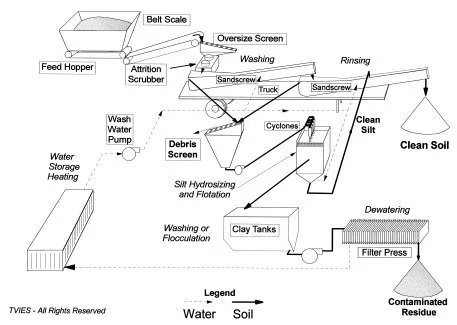
Before the slurry enters the sandscrew, the soil is typically processed through an attrition scrubber.
This stage is critical because contaminated soils often contain:
Clay coatings
Organic films
Fine silt
Cemented particle aggregates
Without proper scrubbing, these coatings bind particles together and increase slurry viscosity, reducing separation efficiency.
Attrition scrubbing mechanically tears apart the soil matrix through intense particle-on-particle rubbing, producing several important benefits:
Liberates mineral grains
Removes surface coatings
Breaks weak agglomerates
Reduces slurry viscosity
Improves settling behaviour
As viscosity decreases, coarse sand particles settle much more rapidly, allowing the downstream sandscrew to perform at maximum efficiency.
How the Sandscrew Separates Materials
Once conditioned by attrition scrubbing, the slurry enters the sandscrew where gravity classification begins.
The separation process follows these stages:
Liberated coarse sand settles quickly because of its higher density and settling velocity.
The rotating screw conveys settled sand upward, simultaneously dewatering the material.
Lighter contaminants remain suspended in the water phase.
Overflow carries undesirable materials away for further treatment or disposal.
Clean sand exits the classifier with significantly reduced contamination.
The result is an upgraded sand product suitable for reuse or further mineral processing.
Benefits in Mineral Processing and Soil Washing
When integrated correctly, sandscrews provide numerous operational advantages:
Efficient removal of lightweight contaminants
High recovery of coarse mineral particles
Reduced clay and organic contamination
Lower moisture content in discharged sand
Improved downstream processing efficiency
Reduced waste disposal costs
Increased opportunity for material recycling
Because sandscrews operate continuously with relatively low maintenance requirements, they remain one of the most cost-effective classification technologies available.
Factors Affecting Sandscrew Performance
Although sandscrews are mechanically simple, their performance depends on proper operating conditions.
Key variables include:
Feed solids concentration
Particle size distribution
Slurry viscosity
Attrition scrubber efficiency
Screw rotational speed
Pool level
Feed rate stability
Failure to optimize these variables can reduce separation efficiency, resulting in misplaced coarse particles or excessive contaminant carryover.
Applications Beyond Traditional Aggregates
Modern soil washing facilities increasingly rely on sandscrews for environmental remediation projects involving:
Contaminated industrial sites
Construction and demolition waste recycling
Mining rehabilitation
Brownfield redevelopment
Dredged sediment treatment
Mineral beneficiation circuits
Their ability to recover reusable sand while removing contaminants supports both environmental sustainability and resource conservation.