Underground Mining Methods: Long hole Stoping vs. Cut-and-Fill Mining
Author: [Ramadhani Santoso - ramadhani@meta-mineral.com ]
Category: underground mining, metalliferous mining, long hole stopping, cut-and-fill mining, underground mine design, mining methods, ore recovery, backfill, narrow vein mining, underground mine engineering
Underground mining presents unique engineering challenges, especially when extracting valuable minerals from narrow, steeply dipping orebodies. Choosing the right mining method is critical to maximizing ore recovery, maintaining worker safety, controlling dilution, and ensuring economic viability.
Among the most widely used underground mining techniques are Longhole Stoping (LHS) and Cut-and-Fill (CAF) Mining. Although both are designed for underground metalliferous deposits, they serve different geological conditions and operational objectives.
Understanding Underground Metalliferous Orebodies
Metalliferous underground mines commonly target vein-type ore deposits, which are typically:
Narrow, ranging from 0.5 to 3.0 meters in width
Steeply dipping, often exceeding 50°
High in economic value
Located deep beneath the surface
These characteristics require mining methods capable of extracting ore efficiently while minimizing waste rock dilution and maintaining ground stability.
Longhole Stoping (LHS): High Productivity Through Bulk Mining
Longhole stoping is a bulk underground mining method designed for competent rock masses and relatively continuous ore bodies.
How It Works
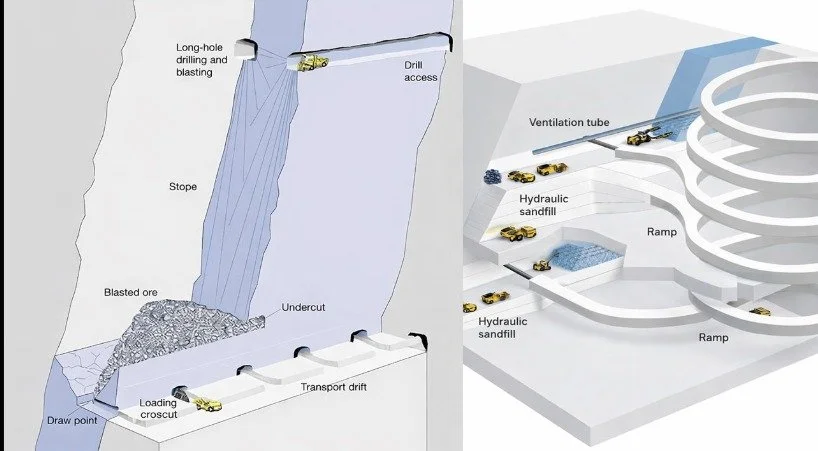
The mining process generally follows these steps:
Development of access drifts and sublevels.
Drilling long blast holes using production drills.
Charging the holes with explosives.
Blasting large sections of ore (stopes).
Recovering broken ore through drawpoints using Load-Haul-Dump (LHD) machines.
Backfilling the stope when required.
This method enables large volumes of ore to be extracted rapidly with relatively low operating costs.
Advantages
High production rates
Lower mining cost per tonne
Excellent equipment productivity
Suitable for mine automation
Reduced labor requirements
Limitations
Longhole stoping performs best only when:
Rock conditions are stable
Orebody geometry is relatively regular
Dilution can be controlled
If the surrounding rock is weak or the orebody is highly irregular, excessive dilution and ore losses may occur.
Cut-and-Fill (CAF) Mining: Precision for Complex Orebodies
Cut-and-fill mining is a selective underground mining method developed for challenging geological conditions.
Instead of blasting an entire stope at once, miners excavate the ore in horizontal slices, beginning at the bottom and progressing upward.
After each slice is removed, the void is immediately filled with engineered backfill before mining continues to the next level.
Mining Sequence
A typical cut-and-fill cycle includes:
Drill
Blast
Muck ore
Install ground support if required
Place backfill
Repeat for the next lift
This cyclic process provides continuous ground support while allowing miners to selectively recover valuable ore.
Advantages
Excellent ore recovery
Minimal dilution
Suitable for irregular orebody shapes
Increased worker safety
Better control of ground stability
Limitations
The increased selectivity comes with trade-offs:
Higher operating costs
Lower production rates
Greater labor intensity
Longer mining cycle times
The Role of Backfill in Underground Mining
One of the defining features of cut-and-fill mining is the extensive use of backfill.
Backfill serves several important purposes:
Supports surrounding rock
Prevents stope collapse
Enables mining beneath previously excavated areas
Reduces surface subsidence
Improves overall mine stability
Modern mines commonly use:
Cemented paste backfill
Hydraulic fill
Rock fill
Cemented rock fill
Backfill technology has become an essential component of safe and sustainable underground mining operations.
Longhole Stoping vs. Cut-and-Fill Mining
FeatureLonghole StopingCut-and-Fill MiningMining styleBulk miningSelective miningProductivityVery highModerateOre recoveryGoodExcellentDilution controlModerateExcellentOperating costLowerHigherGround stabilityRequires competent rockSuitable for weak groundBackfill requirementOptional or delayedImmediate after each liftBest orebody typeRegular, steep, continuousNarrow, irregular, complex
Which Mining Method Is Better?
Neither method is universally superior. The optimal choice depends on several technical and economic factors, including:
Orebody geometry
Rock mass quality
Desired production rate
Ore grade distribution
Dilution tolerance
Ground support requirements
Overall project economics
Operations focused on maximizing production often favor Longhole Stoping, while mines targeting high-value, narrow veins with complex geology typically achieve better results using Cut-and-Fill Mining.