Ball Mill Kinetics: Why Mill Audits Matter and How a Plugged Outlet Diaphragm Can Reduce Plant Performance
Author: [Ramadhani Santoso - ramadhani@meta-mineral.com ]
Category: Mill Audits | Cement | Ball Mill
the ball mill remains one of the most energy-intensive pieces of equipment. Even minor changes in internal material flow can significantly impact production rate, energy consumption, particle size distribution, and cement quality.
A recent mill audit provided an excellent demonstration of ball mill kinetics and highlighted why routine inspections are essential for maintaining optimal grinding performance.
During the inspection, engineers observed an unusually high material level in both grinding chambers. Further investigation revealed that the outlet diaphragm slots were almost completely plugged, causing material to accumulate behind the central outlet screen instead of discharging efficiently.
Although this may appear to be a localized mechanical issue, the consequences extend throughout the entire grinding process.
Understanding Ball Mill Kinetics
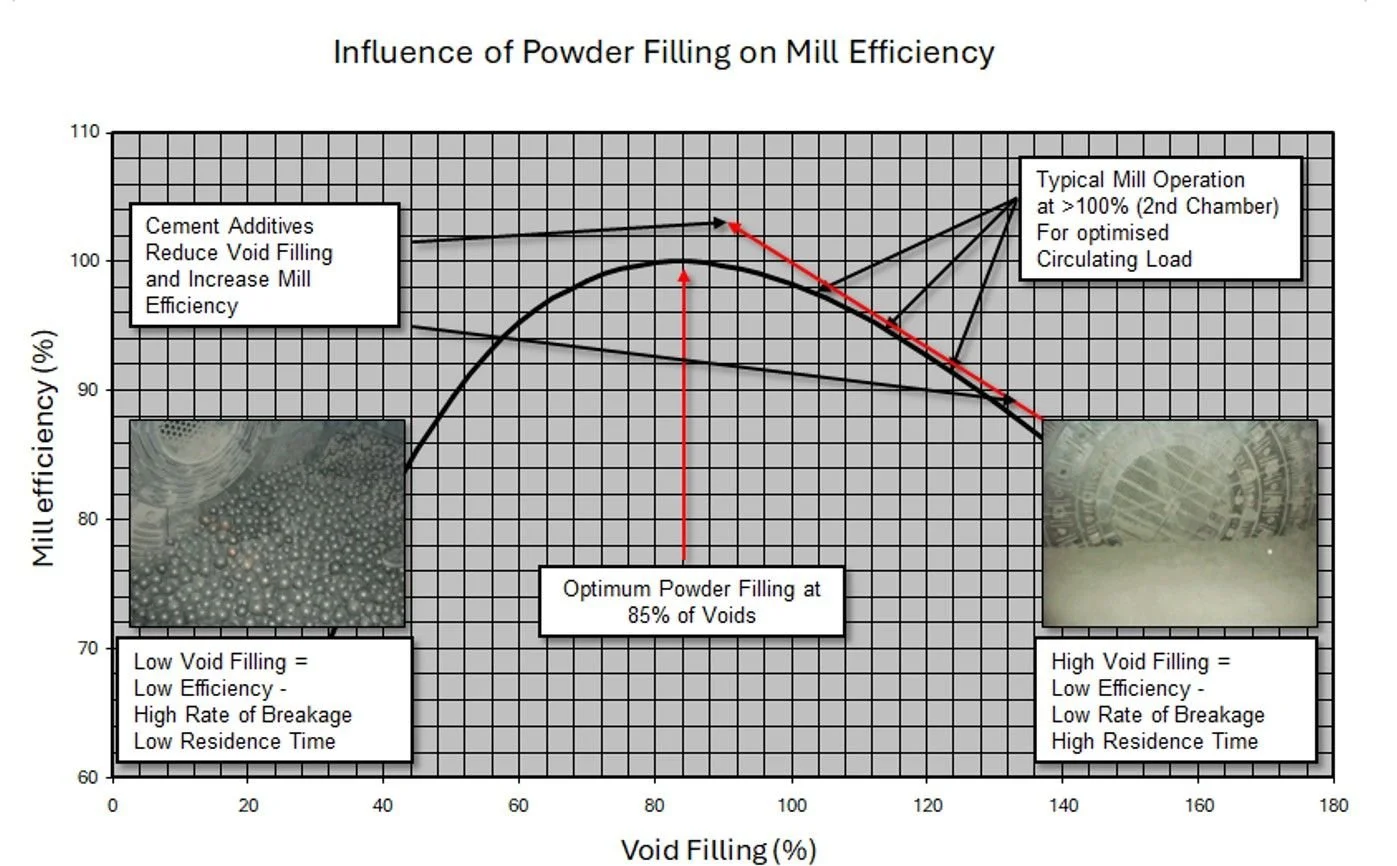
ball mill audit
Ball mill kinetics describe how particles move, break, and exit the mill over time. These dynamics determine several critical operating parameters, including:
Material residence time
Grinding efficiency
Classification performance
Energy utilization
Product fineness
Overall mill throughput
An efficiently operating mill maintains a continuous balance between:
Feed entering the mill
Material grinding inside each chamber
Product exiting through the outlet diaphragm
When any part of this balance is disturbed, the entire grinding circuit becomes less efficient.
What Happens When the Outlet Diaphragm Becomes Plugged?
The outlet diaphragm serves several important functions:
Retains grinding media inside the mill
Allows finished material to exit
Controls internal material flow
Maintains appropriate material levels between chambers
When the diaphragm slots become blocked, discharge capacity decreases dramatically.
Instead of flowing smoothly through the outlet, material begins to accumulate inside the mill.
This increased hold-up alters the internal grinding environment and initiates a chain reaction affecting mill performance.
Chain Reaction Inside the Ball Mill
1. Increased Material Residence Time
The first consequence is a significant increase in residence time.
Material remains inside the mill much longer than intended because it cannot discharge efficiently.
While longer grinding might seem beneficial, excessive residence time often results in:
Reduced production rate
Overgrinding
Higher energy consumption
Increased circulating load
2. Elevated Material Levels
As discharge becomes restricted, both grinding chambers experience rising material levels.
Higher fill levels reduce the available space for grinding media to move freely.
Instead of efficient cascading and cataracting motion, the grinding media become increasingly cushioned by the material bed.
This reduces impact energy and shifts the grinding mechanism toward inefficient attrition.
3. Reduced Grinding Efficiency
An overloaded mill absorbs more energy without producing proportional particle breakage.
Common symptoms include:
Lower mill output
Higher specific power consumption (kWh/ton)
Reduced breakage rates
Poor grinding efficiency
Operators often respond by increasing mill power or adjusting separators, but these actions rarely address the root cause.
4. Product Quality Variations
Restricted discharge affects the particle size distribution of finished cement.
Possible outcomes include:
Increased fine generation from overgrinding
Broader PSD
Variable Blaine fineness
Reduced cement consistency
Maintaining stable material transport is therefore essential for consistent product quality.
5. Mechanical Stress on the Mill
High material levels also increase mechanical loading throughout the mill.
Potential consequences include:
Increased shell loading
Elevated bearing loads
Higher operating temperatures
Greater liner wear
Accelerated diaphragm wear
Left unresolved, these issues can increase maintenance costs and reduce equipment reliability.
Why Mill Audits Are Essential
Many internal mill problems cannot be identified from process data alone.
A professional mill audit combines:
Internal inspection
Material sampling
Particle size analysis
Mill filling measurements
Residence time evaluation
Process data analysis
Equipment condition assessment
These observations provide valuable insight into how the grinding circuit is actually performing.
In this case, the unusually high material level immediately indicated abnormal transport conditions, while inspection confirmed that the outlet diaphragm blockage was the root cause.
Without physically inspecting the mill, operators might incorrectly attribute declining performance to feed characteristics, separator efficiency, or grinding media issues.
Indicators of Outlet Diaphragm Blockage
Plant operators should monitor for several warning signs:
Sudden reduction in mill throughput
Increased mill power draw
Rising differential pressure
Higher material hold-up
Reduced separator efficiency
Variable cement fineness
Higher specific energy consumption
Elevated mill outlet temperatures
Early detection can prevent prolonged production losses and unnecessary maintenance.
Best Practices for Maintaining Ball Mill Performance
To ensure consistent grinding efficiency:
Schedule routine internal mill inspections.
Regularly inspect outlet diaphragm slots for clogging.
Monitor mill power, throughput, and material balance.
Optimize grinding media grading.
Perform periodic particle size distribution analysis.
Conduct comprehensive mill audits during planned shutdowns.
Use process data together with physical inspections to identify hidden bottlenecks.
Conclusion
This mill audit demonstrates how a seemingly simple issue—a plugged outlet diaphragm—can significantly alter ball mill kinetics and reduce grinding performance.
Restricted material discharge increases residence time, raises internal material levels, decreases grinding efficiency, and ultimately affects production capacity, energy consumption, and cement quality.
Regular mill audits are invaluable because they reveal internal process conditions that cannot be detected through instrumentation alone. By combining physical inspections with process analysis, cement plants can identify hidden inefficiencies, improve mill performance, reduce energy costs, and maximize equipment reliability.
For facilities aiming to enhance productivity and optimize operating costs, understanding ball mill kinetics is not just a theoretical exercise—it is a practical strategy for achieving sustainable, high-performance cement grinding.