Hidden Recovery Losses in Flotation: Why Valuable Minerals End Up in Tailings Before Flotation Even Begins
Author: [Ramadhani Santoso - ramadhani@meta-mineral.com ]
Category: flotation feed conditioning, mineral liberation, composite particles, middlings, flotation recovery, High Pressure Slurry Activation (HPSA), mineral processing optimization, flotation efficiency
When flotation recovery drops, the immediate reaction is often to adjust reagent dosage, air rate, froth depth, or residence time. While these parameters certainly influence flotation performance, they may not address the real problem.
In many concentrators, valuable minerals are already "lost" before they even enter the flotation cells.
The issue is not necessarily poor flotation—it is poor particle condition at the flotation feed.
Two common but often overlooked mechanisms contribute significantly to recovery losses:
Composite (middling) particles that remain insufficiently liberated after grinding.
Liberated mineral particles with chemically inactive or contaminated surfaces.
Although these particles fail for different reasons, they both arrive at the same point in the process: the flotation feed. Understanding this bottleneck can unlock significant opportunities to improve recovery without making major changes to the grinding or flotation circuits.
Composite Particles: Valuable Minerals Still Locked with Gangue
Grinding is intended to liberate valuable minerals from waste rock. However, achieving complete liberation for every particle is rarely practical.
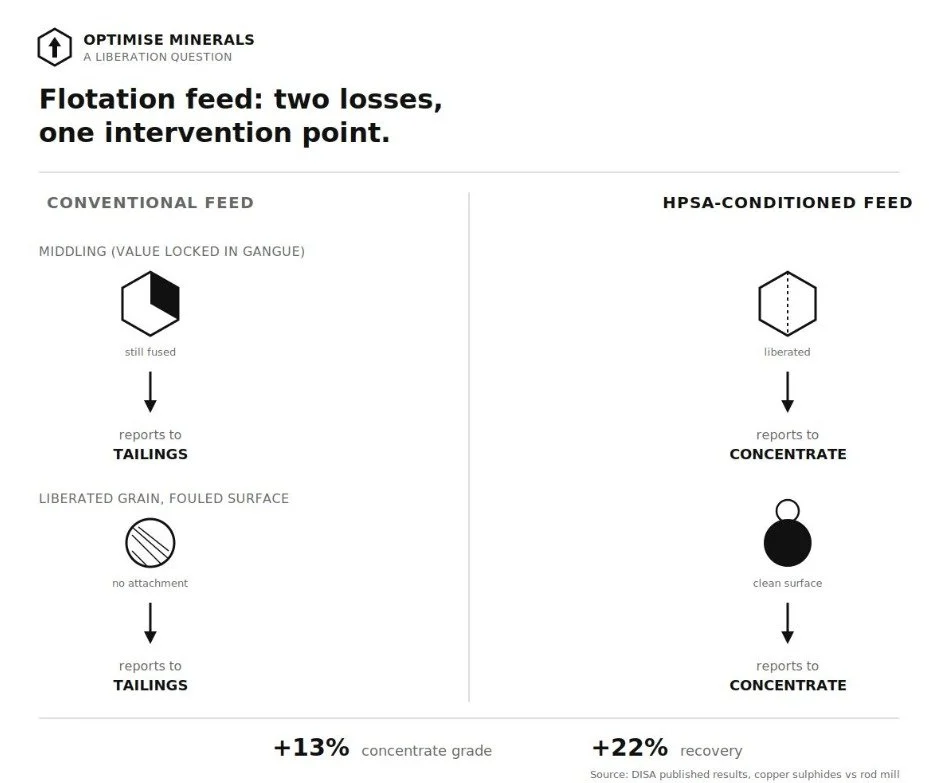
Instead, many particles leave the mill as composite particles, also known as middlings, where valuable minerals remain partially attached to gangue.
These particles present a challenge because only a limited portion of the valuable mineral is exposed to flotation reagents.
As a result:
Collector adsorption is incomplete.
Hydrophobicity is reduced.
Bubble attachment becomes less effective.
Composite particles often behave similarly to gangue minerals.
Rather than reporting to the concentrate, these partially liberated particles frequently enter the tailings stream, carrying recoverable metal with them.
Every composite particle that reaches tailings represents unrecovered value and lost plant revenue.
Liberation Alone Does Not Guarantee Recovery
A common misconception in mineral processing is that liberated particles will automatically float.
In reality, flotation depends on both mineral liberation and surface chemistry.
Even when a valuable mineral is completely liberated, its surface condition determines whether flotation reagents can adsorb effectively.
Several mechanisms can reduce surface reactivity:
Surface oxidation
Slime coating by ultrafine particles
Iron hydroxide precipitation
Clay contamination
Surface passivation during slurry transport
These surface alterations block collector adsorption and reduce the particle's natural hydrophobicity.
Consequently, fully liberated particles may fail to attach to air bubbles and ultimately report to tailings.
This represents a second category of recovery loss that is often invisible during routine plant operation.
Two Different Problems, One Critical Location
Although composite particles and surface-passivated particles originate from different mechanisms, they converge at exactly the same point in the processing plant:
The Flotation Feed
This makes flotation feed one of the most strategic locations for process improvement.
Rather than redesigning flotation cells or modifying the grinding circuit, operators can improve the condition of the particles immediately before flotation begins.
Treating particles at this stage provides an opportunity to recover value that would otherwise be lost.
Why Flotation Feed Conditioning Matters
Traditional plant optimization often focuses on:
Increasing grinding energy
Changing flotation reagent schemes
Modifying cell operating conditions
Installing additional flotation capacity
While these approaches may improve performance, they often require significant capital investment or create new operational challenges.
Feed conditioning offers a different strategy.
Instead of changing the equipment, it changes the particles themselves.
By improving particle condition immediately before flotation, plants can enhance recovery while leaving the existing process largely unchanged.
High Pressure Slurry Activation (HPSA): Conditioning Particles Before Flotation
One technology gaining attention for flotation feed conditioning is High Pressure Slurry Activation (HPSA).
Installed directly upstream of the flotation circuit, HPSA subjects the slurry to intense hydrodynamic energy over a very short residence time.
This treatment produces two important effects simultaneously.
1. Additional Liberation of Middlings
Composite particles often contain weak mineral boundaries that survive conventional grinding.
The intense mechanical forces generated within the HPSA unit can promote further separation of these weakly bonded mineral phases, exposing fresh valuable mineral surfaces without requiring additional milling.
This increases the proportion of particles that are sufficiently liberated for flotation.
2. Reactivation of Mineral Surfaces
At the same time, HPSA helps restore surface activity by:
Removing oxidation films
Dislodging slime coatings
Cleaning mineral surfaces
Increasing fresh surface exposure
The result is improved collector adsorption and enhanced particle hydrophobicity immediately before flotation.
Because treatment occurs only moments before the slurry enters the flotation cells, there is little opportunity for freshly activated surfaces to become re-oxidized.
Advantages of Feed Conditioning
Optimizing flotation feed offers several operational benefits:
Increased recovery of valuable minerals
Improved flotation kinetics
Better reagent utilization
Reduced valuable mineral losses to tailings
No modification of existing flotation cells
No major changes to the grinding circuit
Straightforward integration into existing processing plants
For many operations, feed conditioning represents a practical method of improving plant performance with relatively modest capital expenditure.
Looking Beyond Traditional Flotation Optimization
Historically, flotation optimization has concentrated on the flotation circuit itself.
However, the condition of the particles entering flotation is equally important.
If particles are insufficiently liberated or their surfaces cannot respond to collectors, even the most efficient flotation cells cannot recover them effectively.
By shifting attention upstream to the flotation feed, mineral processors can address hidden recovery losses before they become permanent losses in the tailings storage facility.
Conclusion
Recovery losses often begin long before particles enter the flotation cells.
Composite particles remain locked with gangue, while liberated minerals may become oxidized or coated with slimes that inhibit collector adsorption. Although these mechanisms differ, both reduce flotation performance and contribute to valuable mineral losses in tailings.
Flotation feed conditioning offers an effective solution because it targets both problems at the same location. Technologies such as High Pressure Slurry Activation (HPSA) promote additional liberation of middlings while simultaneously restoring mineral surface activity immediately before flotation.
For operations seeking higher recovery without major plant modifications, improving the condition of flotation feed may represent one of the most practical and cost-effective optimization opportunities available.
Ultimately, successful flotation begins long before the first bubble forms—it begins with delivering every particle to the flotation cell in the best possible condition.